My rating: 5/10
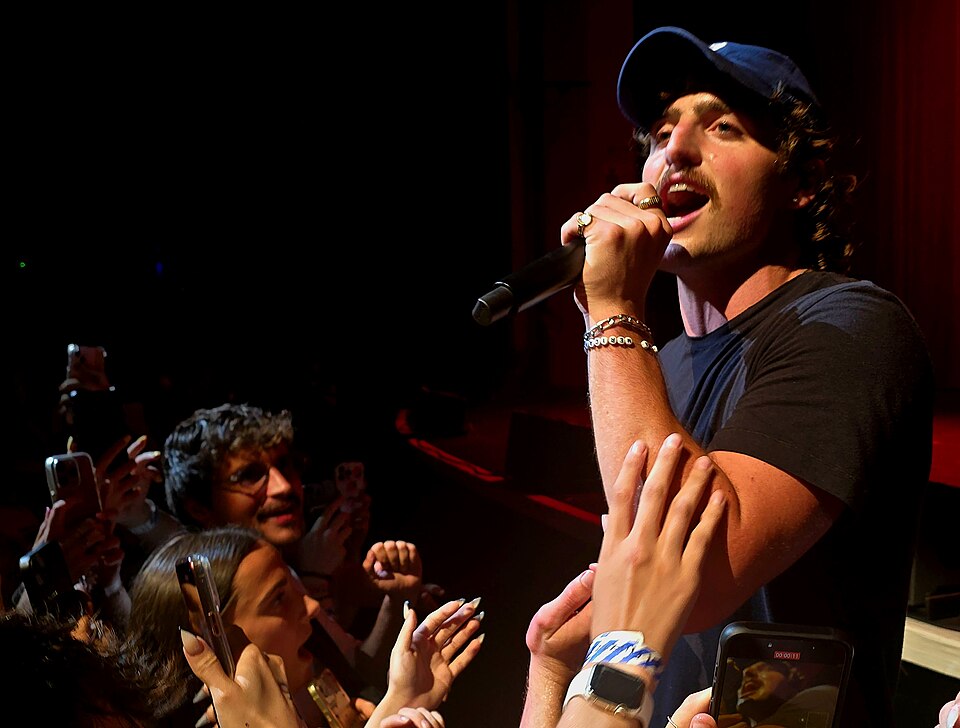
Benson Boone is a 23-year-old American singer-songwriter who rose to fame in 2024 from his viral song, ‘Beautiful Things’ and is known for his flamboyant on-stage backflips. After pulling out of the talent show American Idol in 2021, Boone gained traction on TikTok and now has over 9 million followers, released two studio albums, and later this year will undertake his world tour, already having performed at the GRAMMYs, Coachella and Saturday Night Live, to name a few. What piqued my interest in this album were the mixed reviews it has so far received: Rolling Stone and NME have both rated it 2 out of 5 stars, for example.1 After the success Boone has seen up to this point, I wanted to investigate for myself why this doesn’t seem to have continued. What this ultimately led me to was the implications of TikTok and the way that the streaming platform has impacted the music industry, with the effect of potentially bringing artists rapid and intense fame before they are due/ready for it.
The songs are promising but feel like they’re missing something or are not quite there yet. Often I am hooked by the verse, but then left slightly underwhelmed with the chorus. For example, ‘Man In Me’ begins with a funky beat and unusual dissonant “la’s”, but the chorus is not as catchy or snappy. Similarly, the groovy verse of ‘Mystical Magical’ is let down by the chorus which is repetitive and with interpolations of ‘Physical’ (1981) by Olivia Newton-John, is slightly unimaginative. The pattern continues with ‘Reminds Me Of You’, which begins with a dreamy atmosphere but leads into a simplistic chorus.
Furthermore, the structure is sometimes unclear, such as ‘Sorry I’m Here For Someone Else’, which feels cut short by a new tune at the end which seems a bit random and sounds as if it should be a bridge (the song is only 2:36 minutes). ‘Mr Electric Blue’ also has a sudden calmer moment after the first chorus which for the listener is unclear as to whether it is a bridge or transition section. This returns after the second chorus and instead of the song carrying on as might be expected, it abruptly ends. This also happens in ‘Wanted Man’, in which after just two choruses we are met with a bridge-sounding section which builds in tension as if it is leading into something else; instead, it reaches a dead end and the song finishes. These songs have potential, but there are still lots of areas to improve.
Boone doesn’t seem to have found his own voice yet, and I wonder if he’s trying to be something he’s not. ‘Reminds Me Of You’ is remarkably similar to ‘deja vu’ and the bridge of ‘drivers license’ by Olivia Rodrigo; the melody, beat, and style of the lyrics are very similar. ‘I Wanna Be The One You Call’ is one of the tracks I prefer on the album, but ironically, it reminds me of songs I already like, namely, the beat and muffled harmonies of ‘As It Was’ by Harry Styles and ‘Stuck With Me’ by the Neighbourhood. The lyrics are also quite basic and simple. For example, “you can feel like / Moonbeam ice cream, taking off your blue jeans / Dancing at the movies, ‘cause it feels so Mystical, Magical” in ‘Mystical Magical’ lacks depth and doesn’t make much sense. One positive is that the songs are varied, with differing styles and instrumentation, however, I’m not sure what’s connecting them. There is not much coherence as an album, with no common themes or messages. There are some promising moments, however; as I noted above, I like many of the verses (just not the choruses), and I rate ‘Young American Heart’, which has an upbeat chorus and lively piano and guitar parts; the poignant and sweet homage to his mother, ‘Momma Song’; and ‘Mr Electric Blue’ has a catchy melody. Generally, though, the album lacks some originality.
The TikTok Effect
The album raises issues concerning TikTok stardom. Like many recent artists, Boone rose to fame on the social media platform. It was through his videos that he caught the attention of Dan Reynolds, frontman of Imagine Dragons, who signed Boone to his record label, Night Street Records, and as of February 2024, ‘Beautiful Things’ had been used in over 4 million videos and he has millions of followers.2 Whilst TikTok has given artists a highly accessible platform for their music to gain (sometimes considerable) recognition, (Mitski, for example, went from playing to 2,000 people in 2018 to 20,000 in 2024 after several of her songs went viral on TikTok), what it leaves me wondering is whether this rapid rise to fame is short-lived, or can it be sustained?3 There is evidence that the former might be true. For example, in 2022 singer-songwriter Steve Lacy complained that fans at his shows were only there to film a short section of his song ‘Bad Habit’ which went viral on TikTok; similarly, Joshua Bassett has amassed 3 million followers on the platform, yet struggled to sell tickets for his tour in 2024, reportedly resorting to giving out free tickets to fill seats.4 D’Souza also raises the concern that so many songs go viral on TikTok each day, it becomes increasingly difficult and unlikely for such songs to break through beyond the app.5
Boone’s ‘Beautiful Things’ was a megahit, arguably made as ubiquitous and well-known as it is by TikTok. Having listened to his new album, I wonder whether I would even be reviewing it otherwise. This raises the question of whether these artists deserve such fame; it seems arbitrary compared to others who are equally (if not more) talented and have worked their whole lives for it. As Dahan notes, “A lot of it is out of the artist’s control, and it comes down to how people are going to interpret the work and use it and if any of that happens to pop. There’s a lot of randomness.”6 Is being popular in music more a question of playing the system than talent? Whilst this has always been an inevitable aspect of the music industry (if you want to be big, you must appeal to popular taste) TikTok seems to have brought this to new heights, and accentuates just how unpredictable it can be.
Boone shows much potential with this album; there are some catchy moments and he has a great voice, however, there is still some work to be done. What strikes me is that someone who has performed at the GRAMMYs and gained so much attention can produce an album which has such a long way to go, and the obvious reason for this is the effect of TikTok. The platform can propel artists to fame in an instant if their song happens to go viral, yet without having established a secure fanbase over years of releasing music and cultivating their talent, this fame can be hard to sustain. TikTok has certainly created new considerations for artists and music industry professionals and has changed the way the industry works.
- Spanos, B., ‘Benson Boone Can’t Land the Backflip’, Rolling Stone, (20 June 2025), https://www.rollingstone.com/music/music-album-reviews/benson-boone-american-heart-review-1235368696/, accessed 2 July 2025 ; Bassett, J., ‘Benson Boone – “American Heart” review: a front flip to the middle of the road’, NME , 20 June 2025), https://www.nme.com/reviews/album/benson-boone-american-heart-3871550, accessed 2 July 2025. ↩︎
- Johnson, L. E., ‘He dropped out of ‘American Idol’ 3 years ago. Now, he’s up for a Grammy’, Desert News, (12 November 2024), https://www.deseret.com/entertainment/2024/11/12/who-is-singer-benson-boone/, accessed 2 July 2025 ; Cockerell, C. ‘Who is Benson Boone, the American Idol teen turned TikTok megastar?’, The Standard, (26 February 2025), https://www.standard.co.uk/lifestyle/who-is-benson-boone-american-idol-tiktok-beautiful-thing-b1213224.html, accessed 2 July 2025. ↩︎
- D’Souza, S. ‘The music industry’s over-reliance on TikTok shows how lazy it has become’, The Guardian, (1 March 2024), https://www.theguardian.com/music/2024/mar/01/music-industry-reliance-tiktok-universal-music-group, accessed 1 July 2025. ↩︎
- Ibid. ; Holcomb, C., ‘TikTok Is Creating Overnight Stars—But Many Struggle to Find Real-World Success’, Observer, (20 August 2024), https://observer.com/2024/08/tiktok-is-creating-overnight-stars-but-many-struggle-to-find-real-world-success/, 1 July 2025. ↩︎
- D’Souza, S. ‘The music industry’s over-reliance on TikTok shows how lazy it has become’. ↩︎
- Dahan, E., quoted in Holcomb, C., ‘TikTok Is Creating Overnight Stars—But Many Struggle to Find Real-World Success’. ↩︎