This year’s MTV Video Music Awards had a star-studded lineup, as usual. Awards went to the likes of Taylor Swift, BTS and even Nirvana! But my favourite part is always watching the live performances, and if you missed the show, here are my top 3 performances that I think are definitely worth a watch.
GENER8ION feat. Yung Lean ‘STORM’
If you haven’t seen the choreography for this song yet, it’s a must. Swedish rapper Yung Lean storms onto the stage (see what I did there), throws a chair onto the ground, then takes a VMA trophy and smashes it onto the stage – if this isn’t a bold entrance to an awards show, I don’t know what is!
They’ve recreated the viral music video: on a structure like those used to take school photos, Yung Lean stands, unmoving, in a white shirt, surrounded by a sea of synchronised dancers dressed in dark school blazers. It almost creates the effect that the dancers are one body, moving together like waves. It gives the impression of hope, unity and solidarity, especially when they all throw their blazers off simultaneously, like a magic trick.
The vocals aren’t perfect, but I think this is the point: intentionally out of tune, it sounds raw and real. Licking an ice cream, though, Yung Lean is not even trying to pretend he’s singing along to the backing track – and it’s weirdly refreshing!
It’s a bold statement and an addictive performance – I just want to watch it over and over again, so I can see why it’s become so viral. It also seems to be following a recent trend of artists using a group of dancers to bring their music to life, like Jungle (check out the amazing music videos for their album Volcano). It adds a whole new dimension to the music and lets you experience it in a way you might never have considered otherwise. Check it out below!
Raye – ‘I Will Overcome’ & ‘WHERE IS MY HUSBAND!’
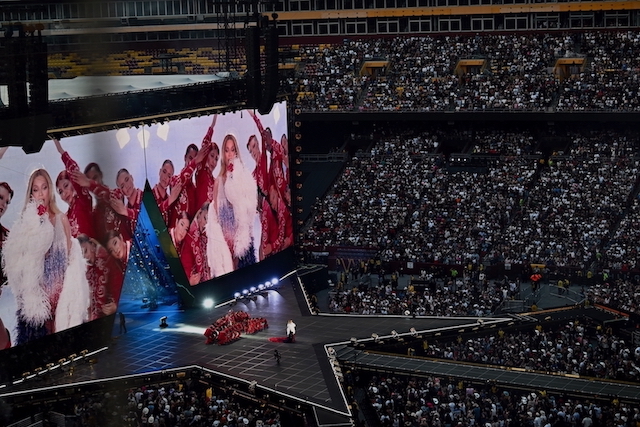
You don’t get much more dramatic than the opening of this performance: Raye dressed in a flamboyant fur coat surrounded by a circle of serious-looking violinists – and the rest of the performance does not disappoint! After her staggeringly powerful high note, the transition from ‘I Will Overcome’ into the next song is flawlessly smooth.
‘WHERE IS MY HUSBAND!’ is such a fun song, and she switches it up by slowing it down then speeding it up again, and even throwing a little Funkytown by Lipps Inc. reference in there. Her talent, as always, is mind-blowing, and she fills the stage with incredible musicians too. Backup singers who accompany her in a style reminiscent of 60s girl groups, a brass ensemble, saxophones, guitars and drums – what more could you ask for? I don’t know how Raye manages to make it look so effortless, but her vocals, dancing and general stage presence give off such joy and energy, which are infectious – and the crowd soaks it up!
Sienna Spiro, ‘Great Expectation’
Sienna Spiro is one of my favourite new artists at the moment – her voice is so emotive, powerful and easy to listen to, and it has such a gorgeous husky tone. The performance opens with her on the stage alone, standing in the middle of a giant record player (as you do). I’ll admit that she does seem slightly nervous initially, but I can’t imagine many of us would be able to perform by ourselves at the VMAs – especially at just 21 years old!
The choreography (unlike the other joyfully chaotic performances) is simple, with her remaining by the microphone whilst the band plays behind her, but her vocals alone are enough to capture the audience. She nails the high note after the bridge – which gave me goosebumps – and seems to relax into the performance afterwards. The live performance is just like the studio recording, if not better – I love the added details and vocal runs, making it a really special performance. I’m excited to see what’s next for her!
COMMENT what you think and let me know which were your favourites!
Ever wondered what traditional Manx folk music sounds like? Yn Chruinnaght, the annual Celtic Music & Dance Festival on the Isle of Man, provides the perfect opportunity to find out! In July, I had the pleasure of attending, and I not only thoroughly enjoyed the music and the sense of community it created, but I was also fascinated to learn about the festival’s history. A story of revival and national pride, it highlights the importance of keeping musical traditions alive.
What is Yn Chruinnaght?
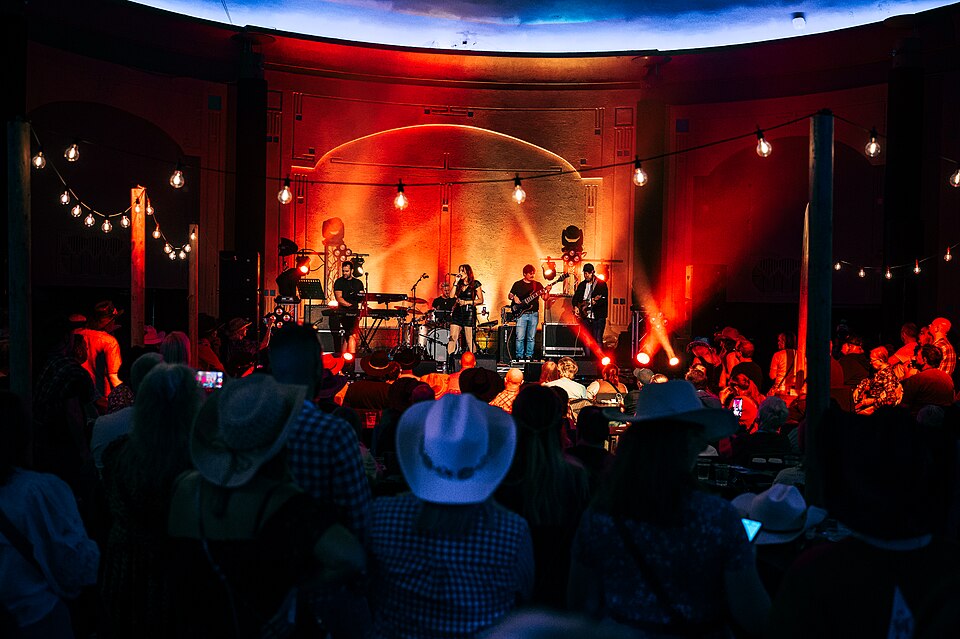
Yn Chruinnaght (Manx for ‘the gathering’) takes place over a week each summer, and this year marked its 48th festival. It features a range of events around the Island showcasing music, dance, language, arts and crafts, lectures and more. What I love about the festival is that it not only celebrates Manx culture, but also the cultures of the five other Celtic countries (Scotland, Ireland, Wales, Cornwall and Brittany). When I visited a local cafe, Noa Bakehouse, to hear the folk sessions, I was pleasantly surprised to hear Cornish music one day, and Welsh the next!
Manx dance group Skeddan Jiarg, Peel 2025
The history of the festival
The festival has a fascinating history steeped in Manx culture. It was originally established in 1924 by William Cubbon under the name Cruinnaght Vanninagh Ashoonagh, which translates to ‘Manx national gathering’ (don’t worry, I can’t pronounce it either!) This sadly came to an end with the outbreak of the Second World War. Luckily, a revival in Manx culture and language in the late 1960s led to the re-establishment of the festival by Mona Douglas in 1977. Whilst the original festival had only featured Manx culture, Douglas decided to expand its scope to include the other five Celtic nations. As mentioned above, this is one of my favourite aspects of the festival. Not only does it allow the audience to hear a variety of folk traditions, but it has attracted musicians and dancers from further afield to the Island to participate, creating opportunities for exciting crossovers to take place.
Scottish folk band Rura, Peel 2025
Awareness of folk culture
Chatting to some of those involved with the festival, it became apparent that it plays a key role in keeping awareness of folk culture and history alive. Kirsty Lawrence, who participates in and has helped organise the festival, noted that it is a celebration of the Island’s history and helps to maintain the Island’s relationships with the other Celtic countries – as a tiny island in the middle of the sea, this is important for us! Dr Chloe Woolley, who does lots of work around the Island to promote and involve people in Manx music, described how successful the festival has been, with large engagement and sold out events. She highlighted that it is a very accessible route into Manx and Celtic culture, and I definitely agree. Even with little to no knowledge about Celtic music or culture, the events are thoroughly enjoyable to attend for people of all ages and from all walks of life.
The Mega Manx Ceili, Peel Cathedral 2025
Not only was the festival a joy to experience, it was fascinating to learn about the history of my hometown. Traditional music allows us to experience a slice of history in an enjoyable and engaging way, and it is important for it to be celebrated! I will definitely be making it a priority to catch next year’s festival.
Let me know if you have anything similar in your own town/city!
(P.s. if you love folk music, check out my interview with the amazing folk trio, Tarren!)
Tapping into her country roots, Taylor Swift wrote this for the new Toy Story movie. With its playful combination of the inherently country instruments, harmonica and banjo, it is a cheerful little love song.
Ella Langley
Be Her
You’ve probably heard of Ella Langley, particularly her track ‘Choosin’ Texas,’ which sat at number one on the Billboard Hot 100 for an impressive 13 weeks! ‘Be Her’ is another popular track from her album Dandelion, and with its snappy, addictive chorus, she sings about who she wants to become: someone who leads a life of simplicity, fulfilment and authenticity.
Sam Barber
The More I Hope
A 23-year-old from Missouri, Sam Barber’s ‘The More I Hope’ is a more melancholy country track. With gentle fiddle and both acoustic and electric guitar, it is heartfelt and reflective, with the raw emotion audible in his voice.
Luke Combs
Sleepless in a Hotel Room
Luke Combs is a Grammy-nominated country singer, and his gravely vocals are on full display in this track. Topping the Billboard Country Airplay chart and marking his 20th number one single, ‘Sleepless in a Hotel Room’ expresses the loneliness of missing his wife on tour. With a cool electric guitar riff and drums, it combines country with rock.
Avery Anna
Blood Runs Thicker
Another track which merges country with rock is ‘Blood Runs Thicker’ by Avery Anna. This is a loud, powerful headbanger which explores the tensions between familial bonds.
COMMENT below what you think of these tracks and share your own recommendations!
Twangy guitars, a strong Alabama accent, and lyrics about ‘two-steppin,’ ‘Jack,’ and the I-40, Ella Langley’s ‘Choosin’ Texas’ is the country track that has been dominating the charts and has been stuck in my head for weeks! This song made Langley the first woman to simultaneously reach number one on the Hot 100, Hot Country and Country Airplay charts. Its popularity follows a trend which has seen country music take off in the past couple of years, and I wanted to explore why and what songwriters can take from this.
Country is a broad genre with a long history, dating back to the 17th Century when British and Irish immigrants brought their instruments and musical styles to the USA. Often covering themes of hardship and tragedy, this music featured stringed instruments such as the fiddle, guitar, violin, bass, and banjo, as well as other instruments such as the harmonica, accordion, and washboard. The genre has, of course, evolved since then and can be heard in a variety of forms. For example, Medium lists a number of sub-genres, from ‘Nashville Pop-Country,’ which, as the name suggests, is influenced by modern pop music, to ‘Traditional Country,’ which has an older sound, to the more satirical ‘Country Rap/Hip Hop.’
Country music has seen a revival in recent years, despite previously seeming to be in decline. It has become a globally popular genre, with country music festivals taking place around Europe, and popular mainstream artists have crossed over into the genre, for example, with the likes of Beyoncé’s Cowboy Carter album and Chappell Roan’s ‘The Giver,’ which reached number one on the Billboard Hot Country Songs. According to Chartlex, in the first half of 2025, country even became the most represented genre in the Billboard Hot 100 Top 10. The genre is particularly popular with Gen Z listeners; Chartlex states that listening in this demographic has increased by 72%, and as country singer Zara Lindeman told ABC News, “There’s a lot of younger people that probably haven’t grown up around the country lifestyle but are still singing about hunting and fishing.”
Elena Popel, a student interviewed for her school newspaper, the Riverdale Review, explained that the reason she prefers listening to country music over other genres is that “There’s no autotune. It’s just the artist and their guitar, and it feels more real. All the artists are really talented.” This makes sense, especially with the rise of AI, which can now write lyrics and produce music from scratch (check out my article on the topic, AI Music: Where Are We Now?). We must be careful when using the notion of authenticity, because ultimately, it is impossible to objectively say if one type of music is more ‘authentic’ than another, but it seems that listeners at least want to feel as if they are listening to music that is genuine. It is becoming increasingly difficult to distinguish between what is real and what is fake in all aspects of our lives, so I can believe that people appreciate the raw, human feel of country music. The use of acoustic instruments (as opposed to electronic ones) and lyrics that are often relatable and with transparent meanings is valuable when everything around us is so complicated. We are fed vast amounts of information and are constantly having to unravel hidden meanings and determine credibility – sometimes we just need a good song to sing along to!
Uplifting
Listening to Langley’s album Dandelion (thanks for the recommendation, Charlotte!), I find it uplifting and laid-back, and this seems to be a characteristic of the genre. I think that when we face lots of pressure as individuals, and there is such negativity in the world, this is what we really need!
What can songwriters take from this?
I do not suggest that all songwriters turn to country – I do not believe in forcing yourself into a genre or style purely because it is popular – always stick to what feels right to you! However, I do think that it is important for songwriters to be aware of this trend and the possible reasons behind it, as it says more about what listeners value than it does the music itself. For example, be aware that perhaps your listeners need to feel like they are seeing your authentic self and to feel uplifted and validated by lyrics that they can relate to and connect to.
Conclusion
A trend not many of us would probably have predicted, 2026 is being dominated by country music – and I do not think this is a bad thing! It brings the easy, uplifting music that we perhaps need in such stressful, demanding and complex times, and songwriters can learn from this.
COMMENT below any country artists/songs/albums that you’ve been enjoying, and if you’re a songwriter, let me know how this trend has impacted your work!
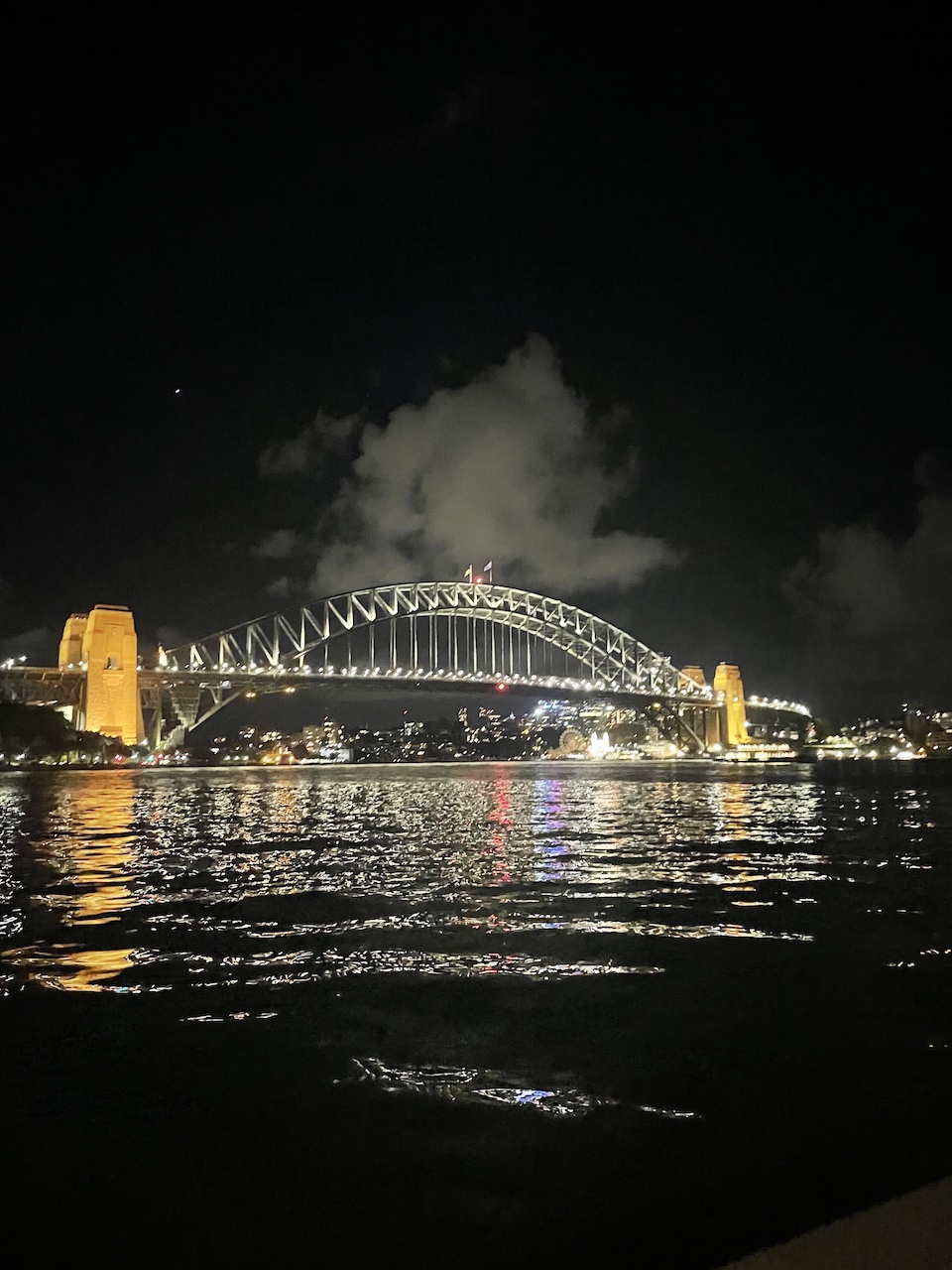
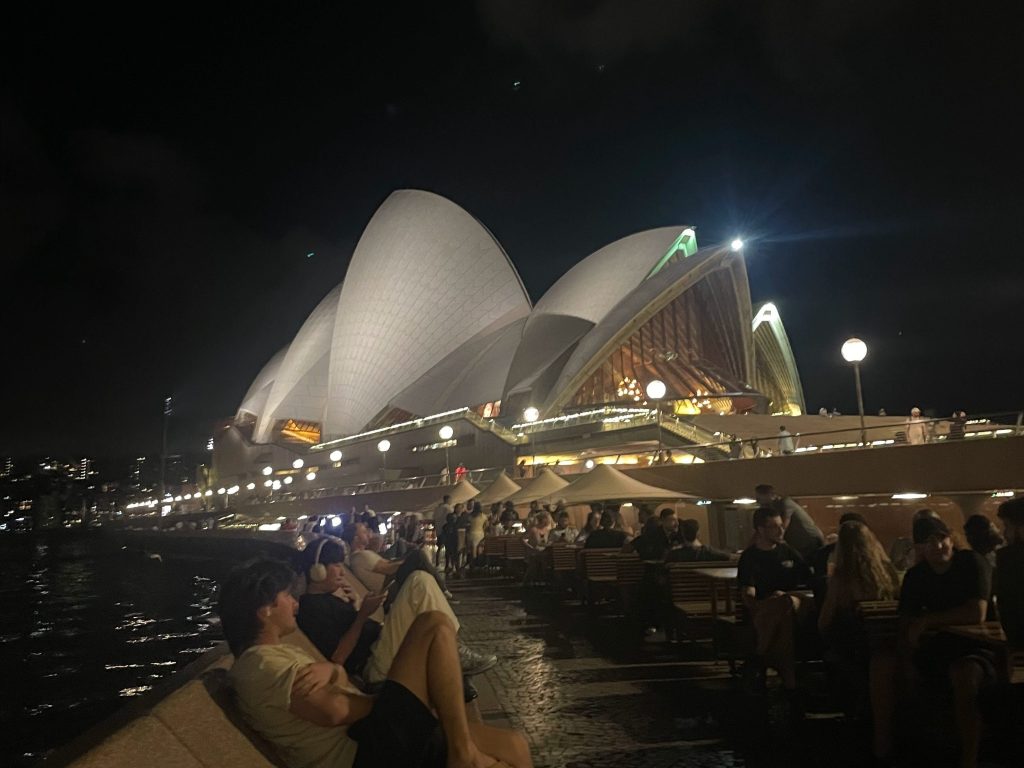
Hear me out. I’ve recently come back from a month-long trip to Australia, hence why this particular topic is on my mind. We listened to the Aussie band, Parcels, A LOT, especially their most recent album, LOVED. I said to Leo, my boyfriend, that there was something about this music that just sounded so Australian to me, and I couldn’t imagine it ever coming out of the UK! Now, this might be entirely in my head, but their music, which is so upbeat and joyful, just reminds me of everything I associate with Australia – the sun, warmth, liveliness and being outdoors. I contrasted it directly with what I tend to associate with the UK – rain, grey, cold and not much to do outdoors (sorry, UK!), conditions which surely make it more likely for slower, sadder music to be created? Whilst there are obviously artists who write sad music in Australia and lively, upbeat music in the UK, I just found it interesting that I even had this thought, and I wanted to research whether music can really be associated with or suited to certain locations.
WhistundaysSydney Opera HouseBrisbane
Evidence? (Or am I being delusional)
I did some research into whether there is any evidence to support this hypothesis, and it seems there are real reasons why an artist’s environment can influence the type of music they write. For example, Alsup describes how artists in urban environments might produce music which reflects the energy and chaos of their surroundings.1 I also found several articles noting how the seasons affect music – not just what type of music is produced, but also what listeners choose to listen to. To illustrate, a Reddit user describes how, when they tried to listen to James Blake’s album, The Colour In Anything, which is “obviously made for cold rainy days,” when the sun was out, “it just didn’t feel right.”2 They also list other albums and the very specific types of settings in which they think they should be listened to. Another user responded,
“As it gets into the autumn/wintertime I find myself listening to quieter, more slow-moving music.”3
Some commenters even note that they associate some music with specific cities, such as “The rising Toronto hip hop/R&B scene is heavily inspired by driving in Toronto at night in the winter” and how the British musician, Burial, is suited for “nighttime south London.”4
Furthermore, in their scientific study, Pettijohn et al. found that their participants “favoured blues, jazz, classical, and folk music (i.e., reflexive and complex) during the fall and winter months, and rap/hip-hop, soul/funk, and electronica/dance music (i.e., energetic and rhythmic) during the summer months.”5 This makes sense, given that the “harsher” winter months are slower and more introspective, and summer is “rife with social activity.” Pettijohn and his team go so far as to argue that these findings could be combined with cognitive behavioural therapy to prevent Seasonal Affective Disorder symptoms. They note that even though listeners might be more likely to listen to reflective music in autumn and winter, these can actually reinforce feelings of isolation and depression, whereas listening to upbeat and high-energy music may help to boost one’s mood.6
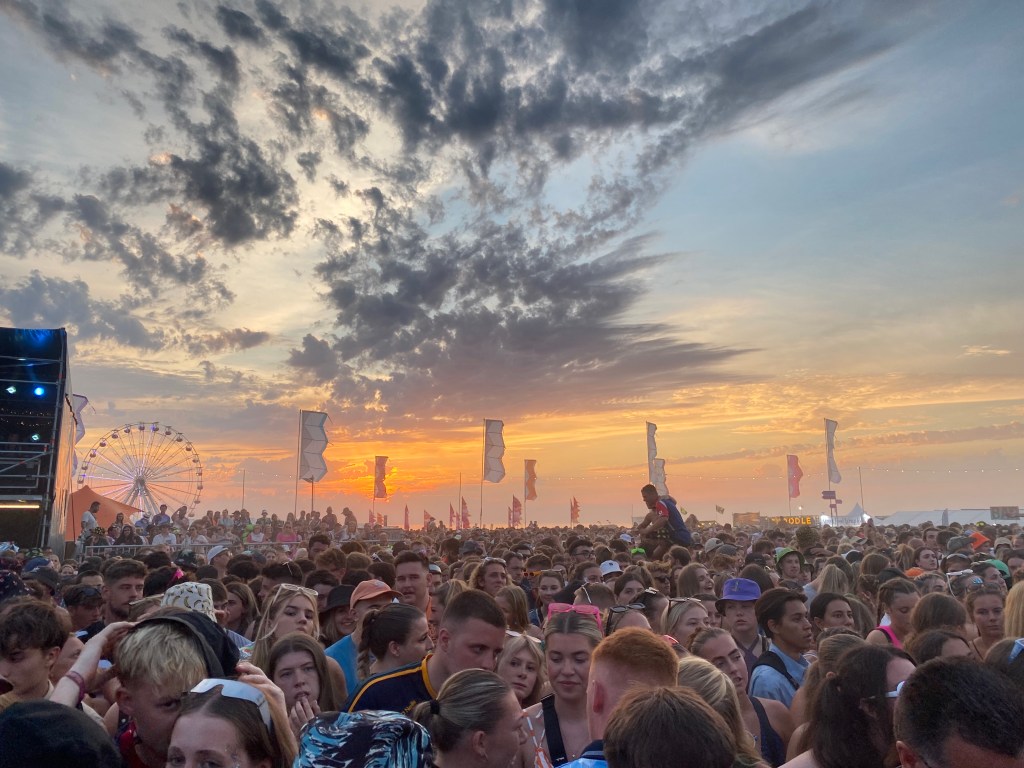
Boardmasters 2021 – an example of the summer being ‘rife with social activity’
Some of the associations people have with certain songs are, of course, also connected to the marketing of the songs. As Jones notes, “we hear about the ‘Song of the Summer’, for instance. Then there are the music videos – what we see and how the artists are portrayed.”7 Inevitably, then, if an artist or band creates music videos in the place that they live, this will consolidate the associations of their music with that specific place.
Essentially, there are several reasons why certain music is associated with different environments, whether that be because it reflects a busy urban environment, is slower so more suited for the winter or more energetic and lively, therefore suited for the summer, or due to the marketing of the song. In short, I’m not crazy!
Parcels – The Sound of Australia?
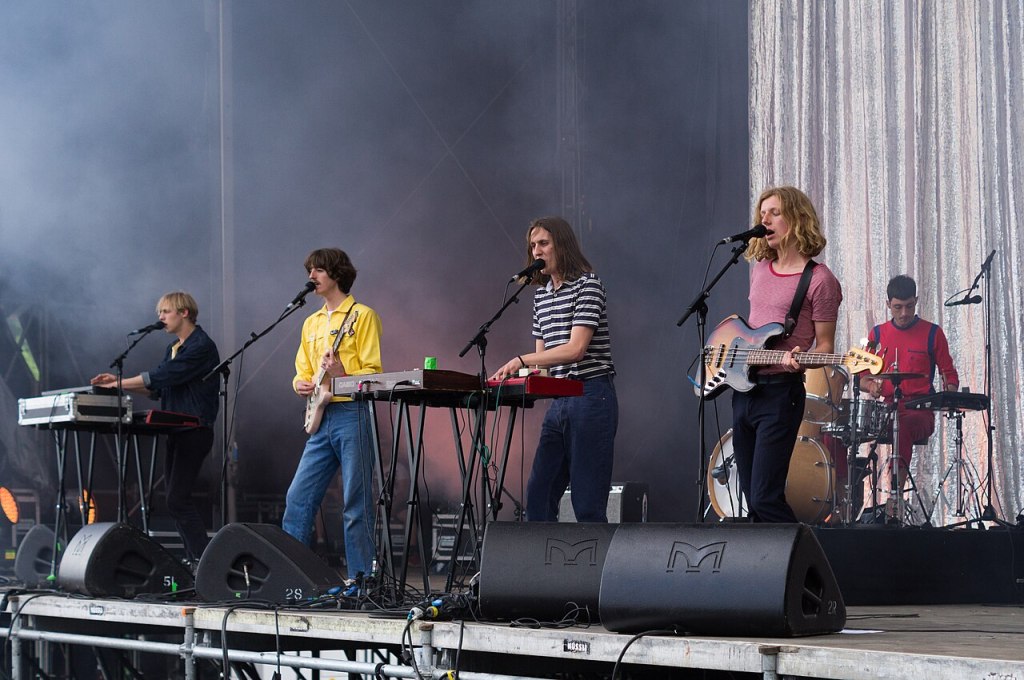
As I mentioned at the beginning of this article, it was how I perceived Parcels as sounding very ‘Australian’ that took me down this route. Let’s see if there’s any hint of truth behind this idea! The band formed in high school in Byron Bay, where “the environment is so relaxed. The lifestyle is pretty incredible and we’re very privileged to be a part of that world.”8 In 2015, they moved to Berlin to pursue their musical career and caught the attention of the one and only Daft Punk at their first-ever gig in Paris! The French electronic music duo not only liked what they heard but invited the band to their recording studio, resulting in Parcels’ single, ‘Overnight.’ If you listen to this track, you will no doubt hear the influences of Daft Punk – the funky guitar riff, prominent bassline and electronic sound effects.
It is not only I who has described their sound in relation to the weather, particularly warm and summery weather, for example, Symth describes how
“they were developing a sound that was pure sunshine”
and that ‘Overnight’ “sounds like it should have come out in the summer of 1977.”9 Parthum notices how “the guitar is often used as an anchor for the songs, leaving the bass to glide with confidence across the soundscape of a neon lit roller rink on a hot summer night.”10
As mentioned above, it was found by Pettijohn et al. that energetic and rhythmic music is often preferred in the summer months, and these two adjectives summarise Parcels perfectly.11 Listen, for example, to ‘Tieduprightnow’ (the first song I head of their’s and what made me fall in love with them!), with its weaving bassline and heavy bass drum; ‘Yougotmefeeling’ which is snappy, catchy and buoyant; and even ‘Sorry,’ a slower and more melancholy track, has a cool groove with a syncopated beat and rhythmic guitar riff. Combined with their light, airy, radiant vocals in a high register, it is impossible not to want to dance along to their music, and it just makes me smile every time!
To strengthen even further this association with summer, and more specifically, Australia, the music video for ‘Tieduprightnow’ is set in Byron Bay and features everything ‘quintessentially’ Aussie, namely, “budgie smugglers, ‘roos, surfing, beach cricket, surf life savers, koalas, lamingtons and shenanigans,” as described by Pégard, who directed the video.12 She describes how when she listened to the track, “all I could picture was summer, the outdoors, surfing and Byron Bay.”13 I think it is safe to say that Parcels’ music is definitely well-suited for summer weather!
Other Aussie Artists
I won’t go into depth about them, but I have found that at least a couple of other Aussie artists have a similar energetic, rhythmic, upbeat and interestingly, electronic style to Parcels, specifically Tame Impala and Empire Of The Sun (the latter I shamefully didn’t even realise were from Australia until a few days ago!) I will leave it to the reader to make their own mind up about whether these artists sound ‘summery’! I would give ‘Let It Happen’ and ‘Borderline’ by Tame Impala a listen, and also ‘We Are The People’ and ‘Walking On A Dream’ by Empire Of The Sun. Let me know what you think!
Conclusion
I obviously recognise that there will be songwriters from Australia who write less energetic music and artists in the UK, for example, who will write very rhythmic and upbeat music. Similarly, everyone’s experiences of music are completely different, and it is possible to listen to ‘summery’ tracks during the winter or on grey and rainy days! I do find it interesting, however, that some of today’s most popular artists from Australia have produced such lively, danceable and ‘summery’ music. It seems to me that there must be some correlation, especially having visited Australia myself, during their summer at least, where people are outside all the time, by the sea, in nature, and being active and sociable. My natural inclination in such a setting is to listen to happy, upbeat and lively music, and I can imagine that (if I were anywhere near as good a songwriter) I’d also be inclined to write such music too!
As we make full headway into 2026, AI will undoubtedly be one of the biggest talking points and considerations for most industries, particularly the music industry. In 2023/24, in my undergraduate dissertation, I considered how the presence of AI would impact the music industry. Two years later, I wanted to check in on its progress. Here’s what I found:
WHAT I PREDICTED IN 2025
First of all, it was clear that AI had scope to improve rapidly – I saw evidence of this within just a few months. Comparing the uncanny debut music video of the first all-AI singer, Anna Indiana, with her most recent songs, it was clear how much the melodies and musical style had improved (she has now released an album, if you are interested!).
Secondly, I predicted that AI used in transparent ways for creative purposes will generally sit more comfortably with people than those trying to mimic humans. As I found with Anna Indiana, there was something eerie about the lack of actual human involvement behind her. Uses for AI, such as the AI Song Contest, where participants experiment and collaborate with AI to create songs, explaining the creative process and the models they used throughout, are much less ambiguous and easier for people to wrap their heads around!
I ultimately reached the conclusion that musicians – and everyone, really – should not be afraid of AI. It is not disappearing any time soon, I’m afraid! In fact, I do think that over time it will become less of a stigma; upon the invention of any new form of technology throughout history, there have been fears and scaremongering about the negative impact that it might have on humanity – whether justified or not – and yet nowadays we don’t think twice about using them in our daily lives, such as the computer, or devices that can play music. Also, as we will see, AI can be used for some really cool things! We should harness it the best we can, or at least be open-minded enough to explore it, so as not to be left behind.
WHERE IS AI NOW?
AI Artists
AI artists have been taken to a new level since Anna Indiana. There has been a flurry of AI artists appearing on the scene, including the R&B-style Xania Monet and the country-style Breaking Rust, both of which made it onto various charts. Other AI-generated songs have also gained traction, such as ‘We Are Charlie Kirk’ by Spalexma, which reached number 1 on Spotify’s Viral 50 songs chart for the USA and globally, and ‘A Million Colors’ by Vinih Pray broke onto TikTok’s Viral 50 chart.
AI singer, Xania Monet
AI singer, Breaking Rust
Could this be the future of music? I’m not convinced. Rather than people’s actual fondness of the tracks, it is more likely the novelty, hype and debate surrounding AI that has attracted such attention to these songs. For instance, whilst I do not think these songs are bad as such, just knowing that they have not necessarily been created or performed by actual humans makes me feel slightly sceptical about them, whether subconsciously or not. In fact, a study by the global music streaming platform, Deezer (2025), showed that “66% of music streaming users say they would listen to 100% AI-generated music at least once, out of curiosity,” but that “45% of music streaming users would like to filter out 100% AI-generated music from their music streaming platform.”
Deezer has also flagged an issue; their AI detection software found that 50,000 AI songs are uploaded to the streaming platform daily, 34% of total uploads (ibid.). They also found that 97% of listeners in their study could not recognise if a track was AI. Not only does this highlight the importance of transparently labelling tracks, i.e. being clearly tagged as AI, but it also has major implications for the distribution of royalties, as we will see.
Legal Implications
One area which I didn’t cover in my dissertation, but which is a vast and complex issue, is the web of legal implications AI creates for the music industry, issues that are only going to multiply as AI gains even more traction. I can only hope to skim the surface here.
As touched on above, the influx of AI songs onto streaming platforms means new structures must be constructed to calculate royalties, such as including detection systems to determine which songs are AI-created, and to what extent. Otherwise, the risk stands that spam AI tracks posing as human artists eat into the royalties otherwise earned by human artists.
Another issue that has caused major legal disputes in the industry is how AI is trained. AI learns from existing material that it finds/is fed, and, unsurprisingly, not all artists are too happy with their music being used to train AI without their consent. This has recently led to the controversy surrounding the track ‘I RUN’ by HAVEN. Released in October 2025 by British producers Harrison Walker and Jacob Donaghue, it used AI-generated vocals. What caught people’s attention was that these vocals sounded like the popular British singer, Jorja Smith, so much so that the track was taken down from Spotify, TikTok and the Billboard charts over allegations of impersonation. The track has now been re-released with the human singer Kaitlin Aragon.
Whether or not the AI used was indeed trained on Smith’s vocals remains unknown, but it poses significant implications for the use of AI in tracks and the legal frameworks surrounding it. For example, major labels such as UMG and Warner have signed deals with the AI music generators Suno and Udio to prevent the use of stolen work, which the labels have already accused Suno and Udio of doing.
It is unclear how many more major changes to the legal landscape of the industry will be made in the coming years with the increasing prominence of AI, but it is clear that there will be many. It is evident to me that emphasis must be put on maintaining maximum fairness for human artists, including the distribution of fair royalties and requiring full consent before their music or vocals are used to train AI. I also believe that full transparency should be required in terms of how a song is created, i.e. to what extent AI has been used, so listeners have full awareness of the nature of the music they are listening to.
Used as a tool
Once it is established how AI can be used in a legal and fair way, it becomes apparent that its capabilities as a tool for musicians are vast and becoming increasingly advanced. Its ability to create new melodies and lyrics, for example, could be used as inspiration; various AI programmes such as LANDR and iZotope allow users to mix and master their tracks from their laptops; and album artwork could be generated using AI image generators. Ultimately, AI allows various aspects of creating and releasing music to be more accessible.
While this understandably leads to concerns over the replacement of human jobs, which is a very real possibility and is already beginning to occur, I believe the best way to stay afloat is to learn how to use AI to our benefit. The rate at which AI is progressing is unlikely to slow down, and so to put it bluntly, we must not get left behind!
A couple of artists in particular have demonstrated just some of the possibilities that AI affords, namely, Grimes, who has agreed to split 50% of the royalties with anyone who creates a successful track using her voice, promoting the “idea of open sourcing all art and killing copyright” (cited in Savage, 2023). Similarly, Holly Herndon created an AI model called Holly+, which allows users to create music using her voice.
There is also evidence that listeners still value genuine human experiences and emotions, something that AI might be able to mimic, but will never be able to feel for itself. I believe this will be a major drawback for AI music. Music is one of the most personal and subjective human phenomena, and to take away this wonderful aspect of the art form would greatly diminish its power. I would argue, therefore, that human-created music will continue to prevail, at least in the meantime. Olivia Dean’s explanation of the truth behind her lyrics summarises this perfectly:
When it comes to music, then, I believe that as long as fair legal frameworks are in place, AI can be used as a tool, but due to the fact that many people value genuine experiences and feelings feeding into the music they hear (which has been the case throughout history), there is no immediate risk that AI music will replace human music.
CONCLUSION
Comparing AI’s current position in and impact on the music industry with 2-3 years ago shows that its capabilities, as expected, have continued to improve, and it is gaining increasing traction, with songs by AI artists actually making it into the charts – Anna Indiana would be proud! However, there is still controversy around AI being used to sound like a human, as seen with ‘I Run’, and it seems that people still put great value on music being injected with genuine human experiences, something that AI simply cannot achieve. Hence, I do not believe that AI music will overtake human music any time soon. At least when it comes to music, then, I see no current risk in at least experimenting with AI and learning how to use it to our advantage, rather than being fearful of it. We must, however, ensure that it is used in a transparent and fair way, being mindful of its legal implications.
These are exciting times, and it will be fascinating to continue watching how AI will develop and how the industry will adapt!
Deezer (2025) Deezer/Ipsos survey: 97% of people can’t tell the difference between fully AI-generated and human made music – clear desire for transparency and fairness for artists.https://newsroom-deezer.com/2025/11/deezer-ipsos-survey-ai-music/ (Accessed 30 Jan 2026).