Ever wondered what traditional Manx folk music sounds like? Yn Chruinnaght, the annual Celtic Music & Dance Festival on the Isle of Man, provides the perfect opportunity to find out! In July, I had the pleasure of attending, and I not only thoroughly enjoyed the music and the sense of community it created, but I was also fascinated to learn about the festival’s history. A story of revival and national pride, it highlights the importance of keeping musical traditions alive.
What is Yn Chruinnaght?
Yn Chruinnaght (Manx for ‘the gathering’) takes place over a week each summer, and this year marked its 48th festival. It features a range of events around the Island showcasing music, dance, language, arts and crafts, lectures and more. What I love about the festival is that it not only celebrates Manx culture, but also the cultures of the five other Celtic countries (Scotland, Ireland, Wales, Cornwall and Brittany). When I visited a local cafe, Noa Bakehouse, to hear the folk sessions, I was pleasantly surprised to hear Cornish music one day, and Welsh the next!
Manx dance group Skeddan Jiarg, Peel 2025
The history of the festival
The festival has a fascinating history steeped in Manx culture. It was originally established in 1924 by William Cubbon under the name Cruinnaght Vanninagh Ashoonagh, which translates to ‘Manx national gathering’ (don’t worry, I can’t pronounce it either!) This sadly came to an end with the outbreak of the Second World War. Luckily, a revival in Manx culture and language in the late 1960s led to the re-establishment of the festival by Mona Douglas in 1977. Whilst the original festival had only featured Manx culture, Douglas decided to expand its scope to include the other five Celtic nations. As mentioned above, this is one of my favourite aspects of the festival. Not only does it allow the audience to hear a variety of folk traditions, but it has attracted musicians and dancers from further afield to the Island to participate, creating opportunities for exciting crossovers to take place.
Scottish folk band Rura, Peel 2025
Awareness of folk culture
Chatting to some of those involved with the festival, it became apparent that it plays a key role in keeping awareness of folk culture and history alive. Kirsty Lawrence, who participates in and has helped organise the festival, noted that it is a celebration of the Island’s history and helps to maintain the Island’s relationships with the other Celtic countries – as a tiny island in the middle of the sea, this is important for us! Dr Chloe Woolley, who does lots of work around the Island to promote and involve people in Manx music, described how successful the festival has been, with large engagement and sold out events. She highlighted that it is a very accessible route into Manx and Celtic culture, and I definitely agree. Even with little to no knowledge about Celtic music or culture, the events are thoroughly enjoyable to attend for people of all ages and from all walks of life.
The Mega Manx Ceili, Peel Cathedral 2025
Not only was the festival a joy to experience, it was fascinating to learn about the history of my hometown. Traditional music allows us to experience a slice of history in an enjoyable and engaging way, and it is important for it to be celebrated! I will definitely be making it a priority to catch next year’s festival.
Let me know if you have anything similar in your own town/city!
(P.s. if you love folk music, check out my interview with the amazing folk trio, Tarren!)
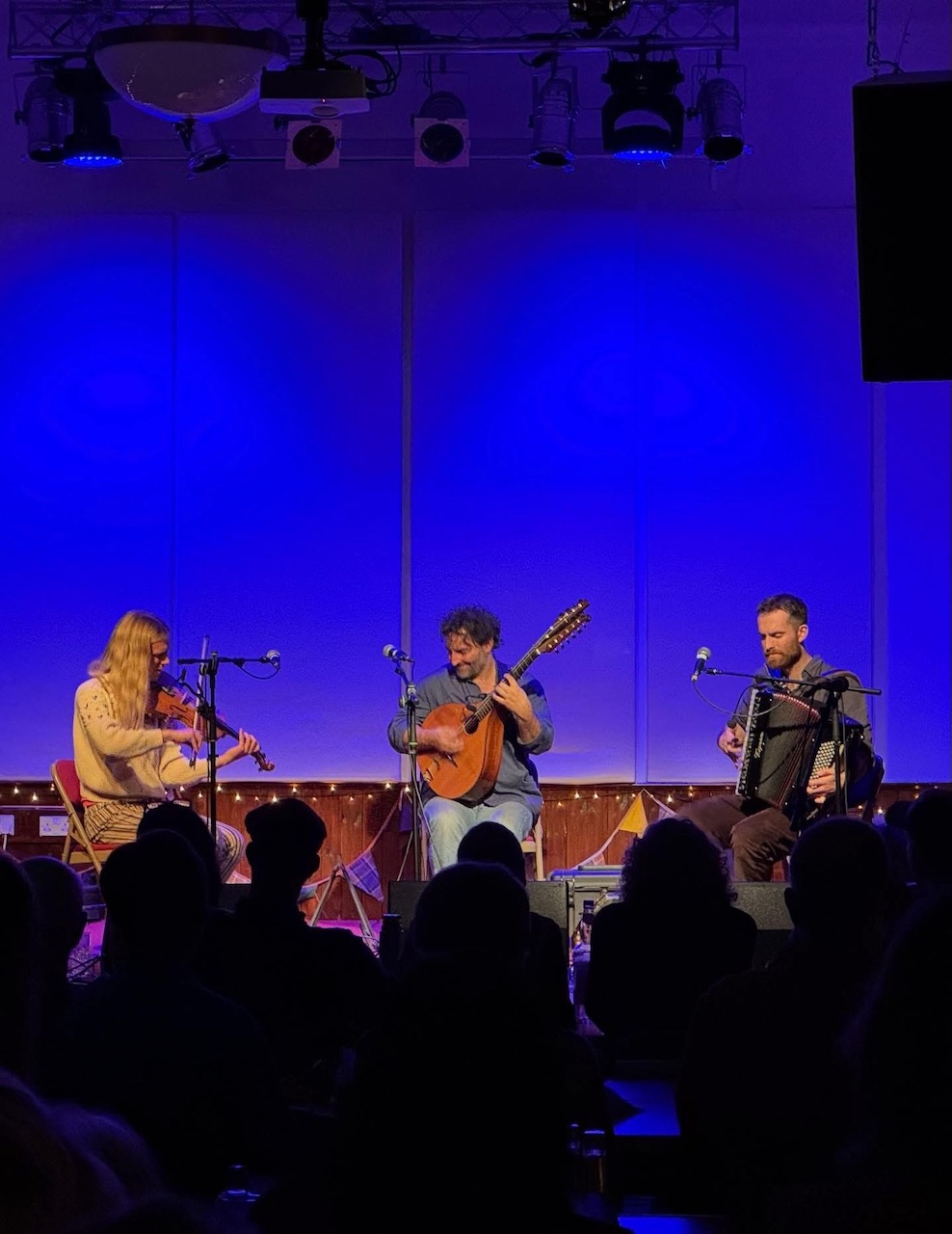
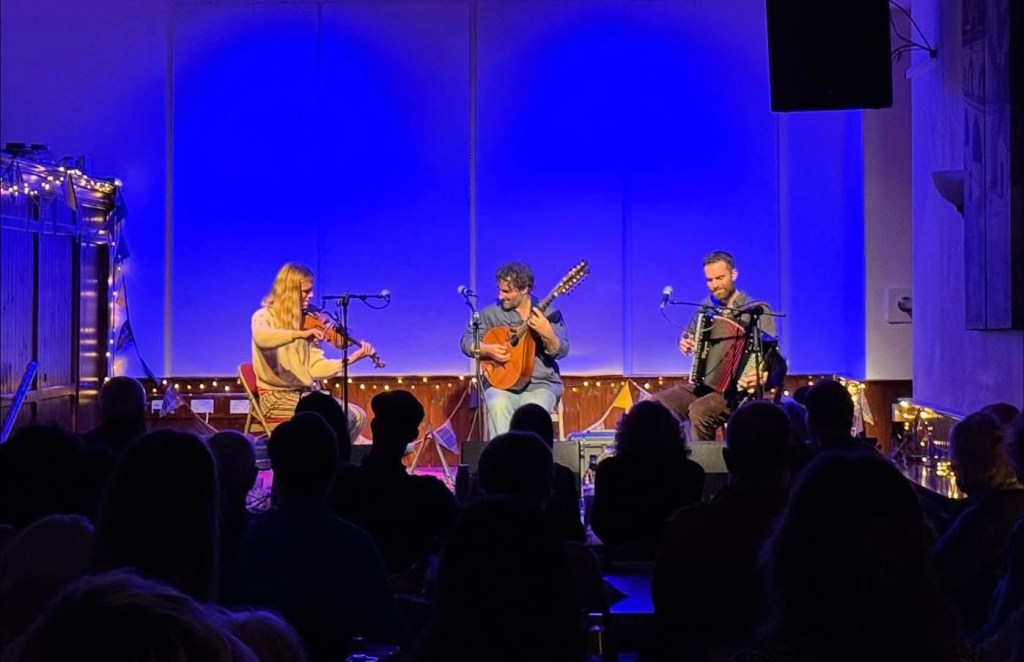
Tarren, a talented and exciting folk trio based in Bristol, comprises Sid Goldsmith on cittern and concertina, Alex Garden on fiddle and Danny Pedler on accordion. The group was formed following the sharing of compositions with each other over lockdown, and their repertoire, which mostly features originals, is rooted in English folk music. They have released two studio albums, both of which have received high acclaim. Bright Young Folk, for example, have described how their latest album, Outside Time, “conveys the joyful energy of their live performances and shows why Tarren are one of the most exciting names on the folk scene”.1 The Isle of Man was lucky to have Tarren visit on their Autumn tour around the UK, playing at the Laxey Working Men’s Institute on 24th October 2025. Before they went on stage, I was able to steal a few minutes with them for a quick chat. I was fascinated to learn about their perspectives on genre and how this feeds into their music, as well as the research they have undertaken into notions of gender in the folk tradition. I’m sure you will become as entranced by their music as I was – I must admit I have played them on repeat ever since!
Tarren at the Laxey Working Men’s Institute, Oct 2025. Photo: John Barker.
The concert was unforgettable, and the music was thoroughly gripping. With melodies that ranged from joyous, for example, ‘Claudia’s,’ to those with a melancholy undertone, such as ‘Super 8,’ all created a powerful atmosphere. The strong rhythmic pulse made it impossible not to tap your foot along, emphasised with moments of syncopation, changes in time signature and the occasional replacement of a beat with a rest, which was highly impactful. There was such intensity and life to the playing, which was infectious, and it is difficult to capture the raw emotion and power of the sound they created in words. They were note perfect, and the ensemble was so tight, which, with such intricate music, was impressive. There were many interweaving layers, constant variation in sound and style, and contrasting intensities – for example, suddenly dying away then building up again. The rich and full sound created from just three people was all-encompassing, with each instrument bringing its own unique texture and dimension, such as the heavy bass of the accordion and the intense and hoarse tone of the fiddle when Alex really dug into the strings; each player getting the most out of their instruments. They were engaging and natural with the audience, coming across as down-to-earth and funny, and they detailed the stories behind the songs, many being relatable and relevant to today, as well as tying to their own personal experiences – more on that soon. Overall, the concert was enjoyable in every aspect.
A unique component of Tarren’s music is their incorporation of classical elements; as they explained to me before the concert, they believe there can be a rub between folk and classical music. They highlighted how
they have not limited themselves to one genre, but make use of all of the tools available to them.
Therefore, they do not belong to one specific camp; hence, they call their style ‘New-Folk.’ They use classical techniques and features, for example, longer structural forms, but inject a folk ‘pulse.’ You can also hear minimalist influences, including repeating and overlapping patterns creating a polyphonic texture and mesmerising harmonies which slide deliciously from one chord to the next – listen out for some of these in ‘Dan-Y-Bont’ below.
I am also reminded of Baroque music, in the way that each line has its own distinct melody and in the clarity of the sound and harmonies.
As the trio poignantly highlighted,
you don’t have to get the form to get the music,
and they demonstrate this perfectly – at the end of the day, it is what resonates with listeners that is important, a sentiment that I fully support.
I believe this flexible mindset should be adopted broadly. The boundaries between musical genres are becoming increasingly blurred; think, for example, of the use of classical timbres such as strings in popular music, and I think this type of crossover should be encouraged more. For example, despite being inspired to play violin after hearing folk music when I was young – I was obsessed with Riverdance! – as a musician who has been classically trained, I have had little to no exposure to playing folk music or using folk methods, such as playing by ear or in an informal group setting, as is folk tradition. Tarren reminds us that there does not need to be a strict divide drawn between genres and that they can (and should!) have a more fluid relationship.
Gender in Folk Music
The trio have done valuable and enlightening research into themes of gender in folk music, and have compellingly adapted traditional songs to align with their own personal experiences and with today’s society. In an article about their research, Danny notes that there are many folk songs, particularly from the 17th and 18th centuries, about ‘warrior women,’ which tell stories of women who disguise themselves as men and subsequently encounter feats they would never ordinarily have faced as a woman, such as entering into battle or acting as highwaymen.2 At face value, these songs might appear as the progressive subversion of gender constraints, but as Danny acknowledges, it is unfortunately not the case. By accomplishing stereotypically ‘manly’ traits such as bravery and virtue, “the woman has excelled at being a man, not broadening what it means to be a woman.” Furthermore, the motivations for these fictional women were usually to follow after a man who had been conscripted, for example, and on their return, they land safely back in their domestic role to fulfil their womanly duties. These songs, in their outrageousness, were merely intended for entertainment, rather than transgressing gender boundaries.
Tarren takes such songs, however, and reinterprets them, using them as a way to broaden the traditional conceptions of gender. Their original composition, ‘Neither Maid nor Man,’ does this elegantly. As Danny notes,
“Folk music is a living tradition; it lives through reinterpretations and additions.”
Featuring re-written versions of ‘The Female Cabin Boy’ and ‘William Taylor,’ where both female and male gender expectations are subverted, the final verse reflects the journey of Tarren’s own Alex coming out as non-binary. It is a subtle yet highly impactful spin on a historical folk tradition, making it relevant to the 21st century and their own experiences.
Tarren are a highly talented trio whose unique interpretation of folk music is utterly captivating. By not confining themselves to a specific genre, they have opened up a range of musical possibilities, as well as reminding us that genre does not have to be so clear-cut. Also, sensitive to the sometimes exclusionary themes of traditional folk songs, they have brought awareness to this and have reinterpreted them to bring them up to date with today’s ever-changing culture and society. Music does not exist in a vacuum – there is no reason that genres cannot be blended, or that traditions cannot be altered to align with the current times.